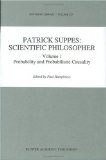
Patrick Suppes is a philosopher and scientist whose contributions range over probability and statistics, mathematical and experimental psychology, the foundations of physics, education theory, the philosophy of language, measurement theory, and the philosophy of science. He has also been a pioneer in the area of computer assisted instruction. In each of these areas, Suppes has provided seminal ideas that in some cases led to shaping the direction of research in the field. The papers contained in this collection were commissioned with the mandate of advancing research in their respective fields rather than retrospectively surveying the contributions that Suppes himself has made. The authors form an interesting mixture of researchers in both formal philosophy of science and science itself all of whom have been inspired by his ideas. To maintain the spirit of constructive dialogue that characterizes Suppes's intellectual style, he has written individual responses to each article.In Volume 1: Probability and Probabilistic Causality, nineteen distinguished philosophers and scientists focus their attention on probabilistic issues. In Part I the contributors explore axiomatic representations of probability theory including qualitative and interval valued probabilities as well as traditional point valued probabilities. Belief structures and the dynamics of belief are also treated in detail. In Part II the rapidly growing field of probabilistic causation is assessed from both formal and empirical viewpoints.
For probability theorists, statisticians, economists, philosophers of science, psychologists and those interested in the foundations of mathematical social science.
In Volume 2: Philosophy of Physics, Theory Structure, and MeasurementTheory, fifteen distinguished philosophers and scientists cover a wide variety of topics. Part III covers issues in quantum theory, geometry, classical mechanics, and computational physics. Part IV explores Suppes's well known set-theoretic account of scientific theories which has served him well throughout his career. Suppes's contributions to measurement theory have been widely used in mathematical psychology and elsewhere, and this material is the subject of Part V.
For physicists, logicians, workers in mathematical social sicence, and philosophers of science.
In Volume 3: Philosophy of Language and Logic, Learning and ActionTheory, fourteen distinguished philosophers and scientists explore issues in the philosophy of language, logic, and philosophical psychology. Suppes's suggestions that quantum theory requires a rethinking of classical logic form a particularly sharp account of that controversial thesis, and Part VI deals with this issue together with topics in the philosophy of language and logic, including relational grammars and anaphora. Part VII deals with issues in psychology, action theory, and robotics, while Part VIII concludes with a general survey of Suppes's views in the philosophy of science. A comprehensive chronological and topical bibliography of Suppes's writings is included in this volume.
For philosophers of language, theoretical linguists, logicians, workers in mathematical social sciences, and philosophers of science.
Idioma: INGLÉS
Patrick Suppes is a philosopher and scientist whose contributions range over probability and statistics, mathematical and experimental psychology, the foundations of physics, education theory, the philosophy of language, measurement theory, and the philosophy of science. He has also been a pioneer in the area of computer assisted instruction. In each of these areas, Suppes has provided seminal ideas that in some cases led to shaping the direction of research in the field. The papers contained in this collection were commissioned with the mandate of advancing research in their respective fields rather than retrospectively surveying the contributions that Suppes himself has made. The authors form an interesting mixture of researchers in both formal philosophy of science and science itself all of whom have been inspired by his ideas. To maintain the spirit of constructive dialogue that characterizes Suppes's intellectual style, he has written individual responses to each article.In Volume 1: Probability and Probabilistic Causality, nineteen distinguished philosophers and scientists focus their attention on probabilistic issues. In Part I the contributors explore axiomatic representations of probability theory including qualitative and interval valued probabilities as well as traditional point valued probabilities. Belief structures and the dynamics of belief are also treated in detail. In Part II the rapidly growing field of probabilistic causation is assessed from both formal and empirical viewpoints.
For probability theorists, statisticians, economists, philosophers of science, psychologists and those interested in the foundations of mathematical social science.
In Volume 2: Philosophy of Physics, Theory Structure, and MeasurementTheory, fifteen distinguished philosophers and scientists cover a wide variety of topics. Part III covers issues in quantum theory, geometry, classical mechanics, and computational physics. Part IV explores Suppes's well known set-theoretic account of scientific theories which has served him well throughout his career. Suppes's contributions to measurement theory have been widely used in mathematical psychology and elsewhere, and this material is the subject of Part V.
For physicists, logicians, workers in mathematical social sicence, and philosophers of science.
In Volume 3: Philosophy of Language and Logic, Learning and ActionTheory, fourteen distinguished philosophers and scientists explore issues in the philosophy of language, logic, and philosophical psychology. Suppes's suggestions that quantum theory requires a rethinking of classical logic form a particularly sharp account of that controversial thesis, and Part VI deals with this issue together with topics in the philosophy of language and logic, including relational grammars and anaphora. Part VII deals with issues in psychology, action theory, and robotics, while Part VIII concludes with a general survey of Suppes's views in the philosophy of science. A comprehensive chronological and topical bibliography of Suppes's writings is included in this volume.
For philosophers of language, theoretical linguists, logicians, workers in mathematical social sciences, and philosophers of science.
Idioma: INGLÉS


 El secreto de la asistenta