{lang: 'es'}
Búsqueda avanzada
Buscar
 

Entra en BiblioEteca...

Disfruta de todo el potencial de biblioEteca entrando con tu usuario...


PERSPECTIVES ON THE FUTURE OF SOFTWARE ENGINEERING


AUTOR: ; ND
 
 
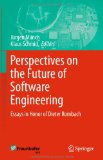
  • Portada de PERSPECTIVES ON THE FUTURE OF SOFTWARE ENGINEERING

    9783642373947

 
Compartir: Compartir con un amigo de biblioeteca Compartir por email Compartir en Facebook Compartir en X Capturar código QR Añadir RSS

Sinópsis del libro:

  • pThe dependence on quality software in all areas of life is what makes software engineering a key discipline for today's society. Thus, over the last few decades it has been increasingly recognized that it is particularly important to demonstrate the value of software engineering methods in real-world environments, a task which is the focus of empirical software engineering. One of the leading protagonists of this discipline worldwide is Prof. Dr. Dr. h.c. Dieter Rombach, who dedicated his entire career to empirical software engineering. For his many important contributions to the field he has received numerous awards and recognitions, including the U.S. National Science Foundation's Presidential Young Investigator Award and the Cross of the Order of Merit of the Federal Republic of Germany. He is a Fellow of both the ACM and the IEEE Computer Society. This book, published in honor of his 60th birthday, is dedicated to Dieter Rombach and his contributions to software engineering in general, as well as to empirical software engineering in particular. /pp /ppThis book presents invited contributions from a number of the most internationally renowned software engineering researchers like Victor Basili, Barry Boehm, Manfred Broy, Carlo Ghezzi, Michael Jackson, Leon Osterweil, and, of course, by Dieter Rombach himself. Several key experts from the Fraunhofer IESE, the institute founded and led by Dieter Rombach, also contributed to the book. The contributions summarize some of the most important trends in software engineering today and outline a vision for the future of the field. The book is structured into three main parts. The first part focuses on the classical foundations of software engineering, such as notations, architecture, and processes, while the second addresses empirical software engineering in particular as the core field of Dieter Rombach's contributions. Finally, the third part discusses a broad vision for the future of software engineering./p

    Idioma: INGLÉS


Clasificador

Según nuestros usuarios

RIGUROSO
Riguroso

Determina lo preciso o impreciso que es este libro con respecto a lo que se cuenta en el mismo. 0 significa que es completamente impreciso y 10 que cuenta es rigurosamente verídico

Más información
DIVERTIDO
Divertido

Determina lo divertido que te ha resultado el libro: 0-aburrido 10-muy divertido

Más información
COMPLEJO
Complejo

Determinamos lo complejo que nos ha resultado la lectura del libro. Desde el nivel más bajo, que indica que es un texto secillo de comprender hasta el valor máximo que indica que es complejo de comprender

Más información
SORPRENDE
Sorprende

Indica lo sorprendente que resulta el argumento del libro, desde 0: previsible hasta 10: totalmente desconcertante y sorprendente

Más información


Etiquetas de otros usuarios

Así han etiquetado este libro más usuarios

Así han etiquetado otros usuarios este libro. Si ves acertada su elección puedes añadir la etiqueta con un simple clic a tus etiquetas

 
Publicidad Baliza v16 Baliza v16


Comentarios de los lectores


Yo Leo

Información para lectores

Anillo de blogs

¿Tienes un blog?

Paga si te gusta

La forma de pago del futuro...

BiblioEtecarios

Ayudanos con los libros

Yo Escribo

Si eres autor, descubre más...

Ayuda

Todo lo que puedes hacer en la web
C/ Mayor, 50, 2C.
28921 Alcorcón (Madrid)
Tel/Fax : 91 288 73 76
E-mail : info@biblioeteca.com

BiblioEteca en Rss

 
Copyright © 2026 BiblioEteca Technologies SL - Todos los derechos reservados