{lang: 'es'}
Búsqueda avanzada
Buscar
 

Entra en BiblioEteca...

Disfruta de todo el potencial de biblioEteca entrando con tu usuario...


SCALABLE OPTIMIZATION VIA PROBABILISTIC MODELING


AUTOR: ; ND
 
 
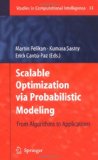
  • Portada de SCALABLE OPTIMIZATION VIA PROBABILISTIC MODELING

    9783540349532

 
Compartir: Compartir con un amigo de biblioeteca Compartir por email Compartir en Facebook Compartir en X Capturar código QR Añadir RSS

Sinópsis del libro:

  • This book focuses like a laser beam on one of the hottest topics in evolutionary computation over the last decade or so: estimation of distribution algorithms (EDAs). EDAs are an important current technique that is leading to breakthroughs in genetic and evolutionary computation and in optimization more generally. I'm putting Scalable Optimization via Probabilistic Modeling in a prominent place in my library, and I urge you to do so as well. This volume summarizes the state of the art at the same time it points to where that art is going. Buy it, read it, and take its lessons to heart. David E Goldberg, University of Illinois at Urbana-Champaign This book is an excellent compilation of carefully selected topics in estimation of distribution algorithms---search algorithms that combine ideas from evolutionary algorithms and machine learning. The book covers a broad spectrum of important subjects ranging from design of robust and scalable optimization algorithms to efficiency enhancements and applications of these algorithms. The book should be of interest to theoreticians and practitioners alike, and is a must-have resource for those interested in stochastic optimization in general, and genetic and evolutionary algorithms in particular. John R. Koza, Stanford University This edited book portrays population-based optimization algorithms and applications, covering the entire gamut of optimization problems having single and multiple objectives, discrete and continuous variables, serial and parallel computations, and simple and complex function models. Anyone interested in population-based optimization methods, either knowingly or unknowingly, use some form of an estimation of distribution algorithm (EDA). This book is an eye-opener and a must-read text, covering easy-to-read yet erudite articles on established and emerging EDA methodologies from real experts in the field. Kalyanmoy Deb, Indian Institute of Technology Kanpur This book is an excellent comprehensive resource on estimation of distribution algorithms. It can serve as the primary EDA resource for practitioner or researcher. The book includes chapters from all major contributors to EDA state-of-the-art and covers the spectrum from EDA design to applications. These algorithms strategically combine the advantages of genetic and evolutionary computation with the advantages of statistical, model building machine learning techniques. EDAs are useful to solve classes of difficult real-world problems in a robust and scalable manner. Una-May O'Reilly, Massachusetts Institute of Technology Machine-learning methods continue to stir the public's imagination due to its futuristic implications. But, probability-based optimization methods can have great impact now on many scientific multiscale and engineering design problems, especially true with use of efficient and competent genetic algorithms (GA) which are the basis of the present volume. Even though efficient and competent GAs outperform standard techniques and prevent negative issues, such as solution stagnation, inherent in the older but more well-known GAs, they remain less known or embraced in the scientific and engineering communities. To that end, the editors have brought together a selection of experts that (1) introduce the current methodology and lexicography of the field with illustrative discussions and highly useful references, (2) exemplify these new techniques that dramatic improve performance in provable hard problems, and (3) provide real-world applications of these techniques, such as antenna design. As one who has strayed into the use of genetic algorithms and genetic programming for multiscale modeling in materials science, I can say it would have been personally more useful if this would have come out five years ago, but, for my students, it will be a boon. Duane D. Johnson, University of Illinois at Urbana-Champaign

    Idioma: INGLÉS


Clasificador

Según nuestros usuarios

RIGUROSO
Riguroso

Determina lo preciso o impreciso que es este libro con respecto a lo que se cuenta en el mismo. 0 significa que es completamente impreciso y 10 que cuenta es rigurosamente verídico

Más información
DIVERTIDO
Divertido

Determina lo divertido que te ha resultado el libro: 0-aburrido 10-muy divertido

Más información
COMPLEJO
Complejo

Determinamos lo complejo que nos ha resultado la lectura del libro. Desde el nivel más bajo, que indica que es un texto secillo de comprender hasta el valor máximo que indica que es complejo de comprender

Más información
SORPRENDE
Sorprende

Indica lo sorprendente que resulta el argumento del libro, desde 0: previsible hasta 10: totalmente desconcertante y sorprendente

Más información


Etiquetas de otros usuarios

Así han etiquetado este libro más usuarios

Así han etiquetado otros usuarios este libro. Si ves acertada su elección puedes añadir la etiqueta con un simple clic a tus etiquetas

 
Publicidad Baliza v16 Baliza v16


Comentarios de los lectores


Yo Leo

Información para lectores

Anillo de blogs

¿Tienes un blog?

Paga si te gusta

La forma de pago del futuro...

BiblioEtecarios

Ayudanos con los libros

Yo Escribo

Si eres autor, descubre más...

Ayuda

Todo lo que puedes hacer en la web
C/ Mayor, 50, 2C.
28921 Alcorcón (Madrid)
Tel/Fax : 91 288 73 76
E-mail : info@biblioeteca.com

BiblioEteca en Rss

 
Copyright © 2026 BiblioEteca Technologies SL - Todos los derechos reservados